Does ‘Female Viagra’ Really Work for Low Libido?
7 minute read
If there was a medication that could make you want sex again — most of us would be clambering to buy it, right?
The promise of a quick fix for low libido in women is tempting. No therapy, no awkward conversations with your partner – just a solution.
That’s the idea behind what is sometimes called “female Viagra” — an injection more formally known as Bremelanotide.
As a sex therapist specialised in low desire, I was keen to learn more. So I sat down with researcher Dr. Glen Spielmans, to talk about the reality behind the drug. And unfortunately, despite being FDA-approved, it doesn’t seem to work miracles. The research leading to it’s approval – reveals a lot about how we think about sex, desire, and women’s bodies.
Prefer to listen instead? Listen to the podcast episode from In Bed with Science: a Sex Podcast, below.
In This Article:
The Promise Of A Quick Fix For Low Libido
Bremelanotide was marketed as a breakthrough for women with low sexual desire.
The idea if that it zeroes in on particular spots, like the melanocortin 3 and 4 receptors in the brain, which scientists believe play a role in sexual desire. When it nudges these receptors, the goal is for it to boost the release of dopamine — the ‘feel-good’ brain chemical — in key areas that affect sexual interest and getting aroused.
However, the drug has clinically documented effects on blood pressure and heart rate. And although it was originally investigated for erectile dysfunction, it doesn’t work like Viagra.
So what are the results of the medication? Well, when Dr. Spielmans & Ellefson looked closely at the trials in their research papers that got the drug approved, the results were underwhelming.
Across two large clinical trials, the difference between the drug and a placebo was tiny. So tiny that you’d have to treat 13 women for just one to feel any meaningful improvement in sexual desire.
And that’s before considering side effects. Dropout due to adverse events was far higher on Bremelanotide than placebo — about one additional woman stopped treatment for every five to six treated. And the side effects ranged from nausea and dizziness, to injection-site reactions.
In total, 42% of participants stopped taking the drug altogether — double the number who quit the placebo.
Here’s where it gets even murkier; after the trials ended, the researchers changed what they considered the main outcome. Originally, they were measuring how many “satisfying sexual events” participants had — which didn’t show much difference.
So they swapped it for a question about distress related to low desire, which, according to Spielmans, made the results look better. This switch (from ‘satisfying sexual events’ to FSDS-DAO #13) is documented in the FDA file and trial registry histories but not in the main trial paper.
Even the way desire was measured raises eyebrows: researchers used the FSFI-Desire subscale — just two vague questions about how often participants felt desire and how strong it was, over the past month. Two questions to capture something as complex, emotional, and context-driven as sexual desire are, in my opinion (and Dr. Spielmans’), not nearly adequate.
And if you’ve ever struggled with low libido, you’ll know it’s not that simple. If it was, you likely would have gotten your desire back pretty quickly.
Quick Fixes for Low Libido – Do They Exist?
In some ways, the birth of Bremelanotide (and Flibanserin, a pill meant to increase desire) is a sign of our times — where we’re trying to reduce something complex, like sexual desire, into a simple biological mechanism.
Kind of the same way social media makes other complicated experiences and diagnoses — like ADHD, depression, burnout, or even trauma — seem simple and easily fixable. As though you only need a supplement or a five-minute hack and everything will be resolved.
And it makes sense that we do this — for multiple reasons.
We live in an increasingly demanding world where the village we once surrounded ourselves with is disappearing. We’re piling more responsibility onto individuals than ever before. We have full-time jobs, we’re the sole caregivers for our children, and we’re expected to meet impossible deadlines and respond to emails at all hours of the day.
We all have too much to do and too little time to do it. And it seems like the pressures on our daily lives just keep increasing.
Technology has solved a lot of problems — but also created new ones. Because now, we’re expected to be joined at the hip with our phones and respond to everything, all the time.
And then on top of that, we’re still meant to want sex at the drop of a hat (or whenever our partner is in the mood!).
But the thing is – with increasing demands comes overwhelm. And overwhelm isn’t conducive to desire. Nor is it conducive to long-term solutions. So we seek out the simple stuff — the things our brains can understand easily, the things that soothe us.
And this, quick fixes like a pill or an injection for desire, become most appealing. Makes sense, right?
WANT YOUR SEX DRIVE BACK?
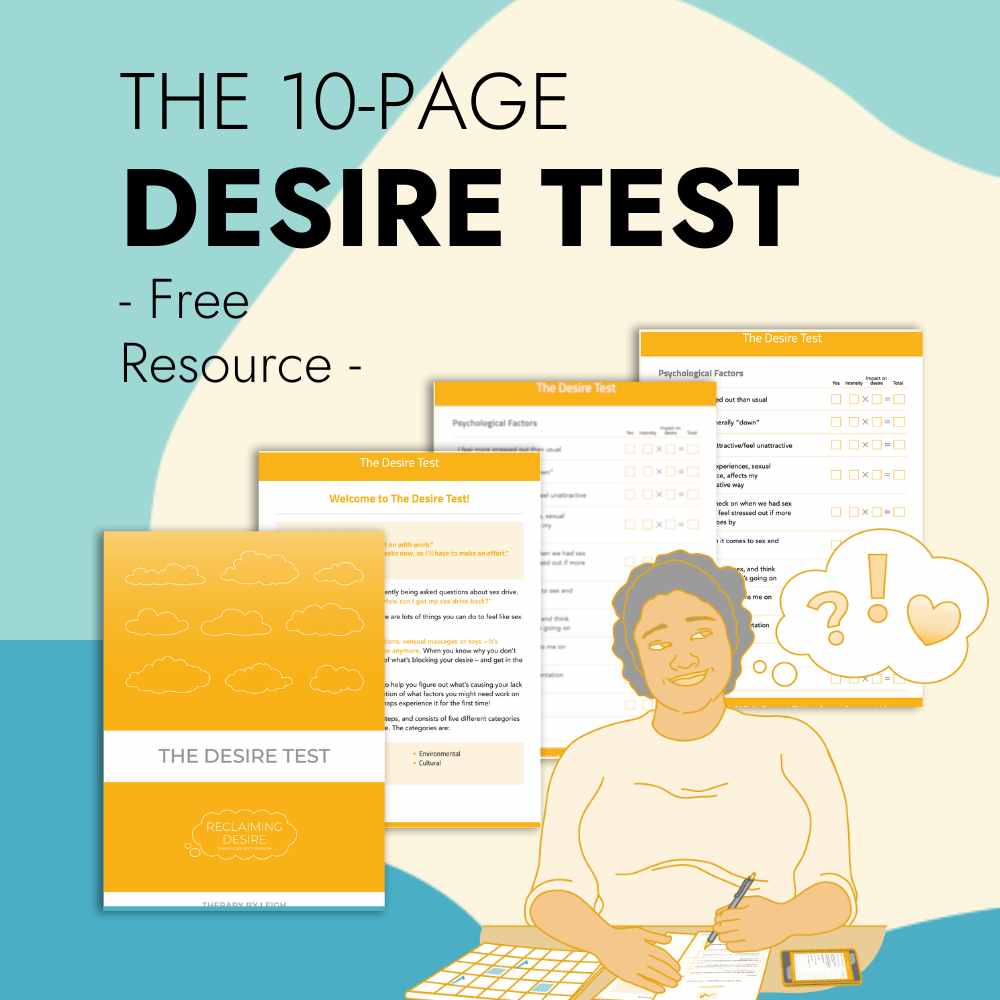
My free resource The Desire Test helps you take that first step towards an increased sex drive, by understanding your decreased desire.
Take the 10-page assessment quiz, get the answers you need to understand what’s standing in the way of your desire, and get free sex and relationship tips directly to your inbox. You can unsubscribe at any time.
Why Sexual Desire Doesn’t Work Like Hunger
The other reason we gravitate toward solutions like medication, is that we’ve been taught desire is purely biological — a drive, like hunger or thirst. But desire is so much more complicated, and isn’t only driven by our biology.
It’s also made up of and influenced by psychological, relational, and cultural factors.
- Psychological factors like work stress, self-confidence, or shame
- Relationship factors like emotional distance, conflict, or resentment
- Cultural factors like how we think desire “should” work in long-term relationships, or growing up in homes where sex was taboo
Just like Dr. Spielmans said in the podcast — desire isn’t a switch you can turn on or off. No matter how much we wish it would be. So it’s no wonder that a drug created to “fix” something this complex doesn’t seem to be very effective.
What To Focus On Instead If You Want Your Desire Back
Just because desire is complex — doesn’t mean you can’t get it back. On the contrary, there are lots of things you can do to feel in the mood again.
It starts when we stop chasing quick fixes like lingerie and new positions – and begin to look at the reasons why libido is gone in the first place. Because once you zero in on the factors responsible, that’s when you can start to desire sex again.
If you want to explore what’s affecting your desire right now, you can take The Desire Test — my free resource that helps you pinpoint what’s blocking your libido and what to focus on next.
And if you’d like support as you work through this process, my 1:1 online program Re:Desire is open for enrollment.
In Re:Desire, I help you want sex again and have more and better sex – without scheduling it.
You learn how to access desire from a place of zero pressure. Because it’s likely still there within you – you just can’t find it right now. And while it’s not a “female Viagra,” it’s a science-backed, compassionate way to reignite your desire — no side effects required.
Zero sex drive?
You’re not alone! Download the 10-page Desire Test to find out why your desire for sex is gone (and what to do about it).
Questions based on a variety of factors proven to negatively affect desire

Find out which factors are responsible for your low or non-existent sex drive
Get instant access to expert advice, delivered directly to your inbox when you download The Desire Test. Unsubscribe anytime.
WANT TO KNOW MORE ABOUT THE DESIRE TEST?


With 9 years of experience as a sex therapist and coach - Leigh helps her clients create stress-free, shame-free, pressure-free sex lives, through her unique combination of sexological science, & psychotherapeutic & coaching tools.